

7 Best Mercedes Diesel Performance Mods

A Mercedes diesel rarely feels slow because of one hard limit. More often, it feels held back by conservative torque management, soft transmission behavior, and factory calibration that leaves a wide margin on the table. That is why the best Mercedes diesel performance mods usually start with software and supporting hardware that improve the entire power delivery strategy, not just peak horsepower.
For most CDI and BlueTEC platforms, the right path depends on the engine, transmission, emissions configuration, and how the vehicle is used. A daily driven E-Class diesel needs a different approach than an ML, Sprinter, or a heavily loaded SUV used for towing. The strongest builds are not random parts stacks. They are matched systems built around clean data, predictable exhaust gas temperature control, and transmission behavior that can actually manage the added torque.
What makes the best Mercedes diesel performance mods worth doing
Mercedes diesel platforms respond well to tuning because the factory setup is engineered around broad operating conditions, fuel quality variation, emissions strategy, and long service intervals. That leaves room for better boost targeting, revised fueling, sharper throttle mapping, and more efficient shift logic.
The key is restraint. A good modification improves usable torque, transient response, and drivability without pushing the turbocharger, fuel system, or transmission beyond reasonable limits. On these vehicles, the best result is rarely the most aggressive file or the largest advertised number. It is the setup that feels stronger everywhere and remains consistent under load.
1. Precision ECU calibration is the foundation
If the goal is real performance, ECU tuning is the first mod to do. On Mercedes diesel applications, proper calibration changes the way the vehicle delivers torque across the entire rev range. Boost control, injection timing, rail pressure targets, torque intervention, and throttle response can all be refined to produce a stronger and more linear powerband.
This is where platform knowledge matters. A generic tune may produce a noticeable gain, but it often ignores important variables such as turbo efficiency range, thermal load, transmission limits, and known weaknesses in specific engine families. A data-driven calibration built around logging and validation is what separates a strong daily driver from a vehicle that feels fast for a week and then starts exposing drivability issues.
On many Mercedes diesels, ECU calibration also improves part-throttle response. That matters more than dyno-sheet marketing because it changes how the vehicle feels in passing, merging, and towing situations.
2. Transmission tuning often matters as much as engine tuning
One of the most overlooked Mercedes diesel performance mods is transmission software. That is a mistake, especially on torque-rich diesel applications where the transmission has a major effect on acceleration, response, and long-term drivability.
Factory transmission programming often prioritizes smoothness, fuel economy targets, and torque intervention. Once engine torque is increased, stock shift strategy can feel lazy or inconsistent. Transmission calibration can adjust shift timing, clutch pressure, torque limiter behavior, and gear selection logic so the drivetrain works with the added torque instead of dampening it.
The benefit is not just faster shifts. The vehicle feels more decisive. Downshifts happen when expected, upshifts occur with better control under load, and the engine stays in a more effective part of the powerband. On many builds, transmission tuning is the difference between a tuned diesel that feels stronger and one that actually feels sorted.
3. Intake and airflow mods help when they solve a real restriction
Airflow upgrades are common, but they are not always necessary on a mild setup. Mercedes diesel intake systems are not universally bad, and replacing parts without understanding the restriction point can waste money.
That said, there are cases where intake improvements make sense. If the stock airbox, inlet tract, or charge piping is becoming a bottleneck at higher load, an airflow-focused upgrade can support better turbo efficiency and help maintain target boost with less effort. The same applies if factory components are aged, cracked, or contaminated.
The main rule is simple: choose airflow mods that support the calibration, not ones that only change sound or appearance. Diesel performance responds to pressure control, charge temperature, and consistent airflow more than visual hardware changes.
4. Intercooler upgrades become valuable as power and load increase
Heat is where many diesel builds stop feeling strong. A Mercedes diesel can produce excellent torque, but as intake air temperatures rise, the ECU may reduce performance to protect the engine and emissions system. That is especially relevant in heavy SUVs, towing applications, warm climates, and repeated acceleration runs.
A more efficient intercooler can stabilize charge temperatures and improve consistency. It may not deliver dramatic gains on an otherwise stock vehicle, but once tuning is added, thermal control becomes much more important. Lower and more stable intake temperatures support repeatable performance and can reduce stress on the turbo system.
This is one of those it-depends modifications. For a lightly tuned commuter, the stock intercooler may be adequate. For a vehicle with aggressive calibration, frequent load, or additional airflow upgrades, it becomes much easier to justify.
5. Exhaust changes can help, but only if they match the vehicle's use
Exhaust modifications on Mercedes diesels are often discussed in absolute terms, but the right answer depends on the platform and local compliance requirements. On some builds, reducing backpressure can improve turbo response and support better top-end flow. On others, the measurable benefit is modest unless paired with calibration and additional hardware.
The bigger point is that exhaust work should be planned, not improvised. Pipe sizing, sensor strategy, emissions equipment configuration, and tuning all need to agree with each other. If they do not, you can trade a small performance gain for poor cold-start behavior, fault codes, smoke, or unstable drivability.
Owners focused on refined street performance usually benefit more from a properly calibrated system than from chasing the loudest or most aggressive exhaust setup.
6. Turbocharger upgrades are for owners who have outgrown stock hardware
A turbo upgrade can transform a Mercedes diesel, but it should not be treated as an entry-level modification. The stock turbo on many diesel Mercedes models is capable of impressive gains when paired with proper ECU and transmission calibration. Only after the factory unit becomes the limiting factor does a turbo upgrade start making technical and financial sense.
Once you move to a larger or hybrid turbo, the project changes. Boost control strategy, fueling, intercooling, exhaust flow, and transmission behavior all need to be recalibrated. Spool characteristics also change, and not always for the better if the setup is too large for the engine's intended use.
For a street-driven diesel, the best turbo upgrade is usually not the biggest one. It is the one that expands the usable torque curve without creating lag, heat management problems, or transmission complaints.
7. Supporting maintenance is a performance mod on aging diesels
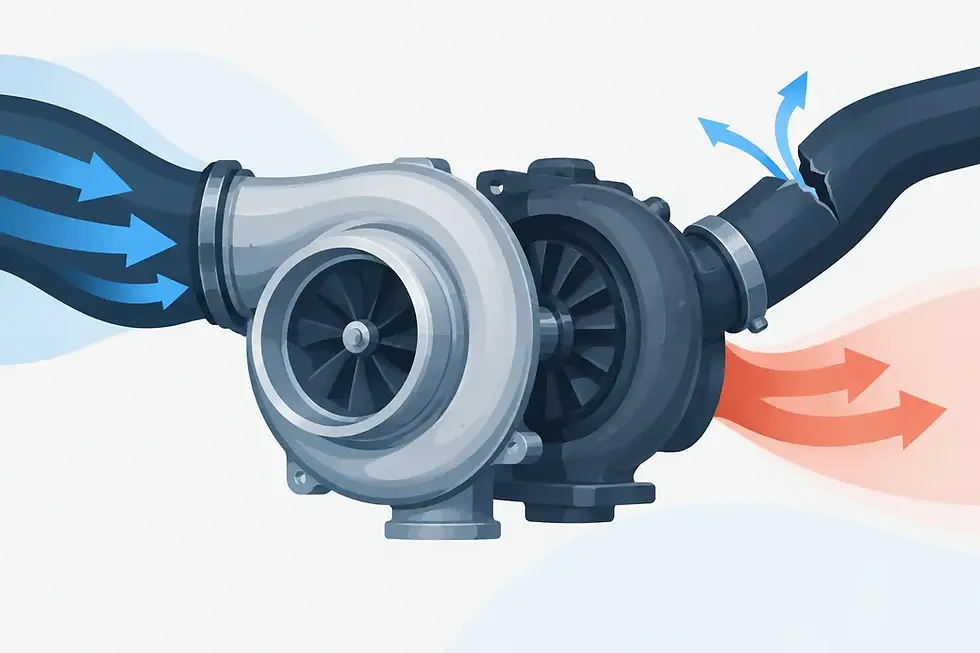
This may be the least exciting answer, but on older Mercedes diesel platforms, baseline mechanical health often determines whether performance mods work as intended. Boost leaks, weak charge hoses, tired sensors, injector imbalance, carbon buildup, and transmission adaptation issues can all make a tuned vehicle feel worse than a healthy stock one.
Before adding power, it makes sense to verify actual boost, fuel delivery, sensor accuracy, and transmission condition. This is particularly important on OM642-equipped vehicles and other high-mileage diesel platforms where small faults can compound quickly under added load.
In practice, some of the best Mercedes diesel performance mods are not glamorous. Replacing leaking charge pipes, correcting air metering errors, and addressing module faults can restore the consistency needed for calibration to deliver its full result.
How to choose the right combination
If the vehicle is a daily driver, start with ECU calibration and, where available, transmission tuning. That combination usually gives the best return in torque, response, and drivability.
If the vehicle tows, runs in hot conditions, or sees repeated heavy load, add thermal management to the conversation early. An intercooler and careful calibration strategy can matter more than a flashy intake part.
If the goal is a higher-output build, plan the package together. Turbo, fueling strategy, airflow, transmission behavior, and diagnostics all need to align. This is where a specialist with Mercedes diesel experience, proper logging, and dyno validation becomes far more valuable than an off-the-shelf file.
At ECUPROGRAM, that is the difference we pay attention to - not just whether a mod adds power, but whether the whole vehicle becomes sharper, cleaner, and more predictable under real use.
Best Mercedes diesel performance mods by priority
For most owners, the priority order is straightforward. Start with ECU calibration, then transmission tuning, then address airflow and thermal control if the setup demands it. Exhaust and turbo changes come later, once the stock system has been evaluated and the performance target is clear.
That order matters because diesel performance is torque management first, hardware second. A well-calibrated Mercedes diesel with the right supporting setup will usually outperform a poorly planned parts build while feeling smoother and lasting longer.
If you want your Mercedes diesel to feel meaningfully stronger, start with the modifications that improve control, not just capacity. The best build is the one that makes the vehicle faster in a way you can trust every time you drive it.


Comments