

How to Optimize Diesel Shift Points for Better Response
- Miguel Acha
- 18 hours ago
- 5 min read

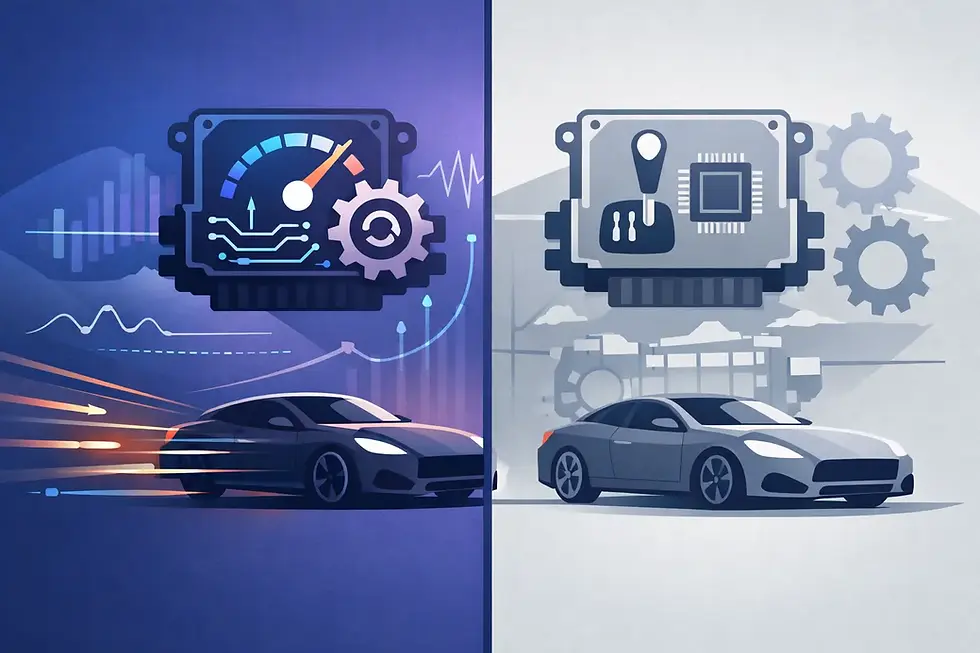
A diesel that pulls hard but shifts at the wrong moment never feels properly calibrated. It may upshift before the engine reaches its most useful torque band, hang onto a lower gear after acceleration has faded, or hunt between ratios on a grade. Knowing how to optimize diesel shift points means treating the engine and transmission as one torque-management system, not chasing a single RPM number.
For premium European diesel platforms, this is especially relevant. Mercedes-Benz CDI and BlueTEC, VW and Audi TDI, BMW diesel, and late-model ZF-equipped vehicles use interconnected engine, transmission, boost, temperature, and driver-demand models. A meaningful change requires data-driven calibration and validation under the conditions where the vehicle is actually used.
What a Diesel Shift Point Really Controls
A shift point is the moment the transmission software commands an upshift or downshift based on inputs such as throttle position, requested torque, engine speed, vehicle speed, gear selection, transmission temperature, gradient estimation, and selected drive mode. On modern automatics, it is rarely a fixed RPM threshold.
The objective is not to keep the engine at peak torque at all times. The best shift event places the engine in the next gear where it can produce more usable wheel torque than it could by staying in the current gear. Gear ratio spacing matters as much as the engine's torque curve. A transmission that shifts at 3,200 RPM may drop the engine to 2,100 RPM, while another ratio set may land at 1,700 RPM. Those outcomes require different calibration decisions.
Diesels complicate the picture because their effective power band is usually narrower than a comparable gasoline performance engine. They generate substantial low- and midrange torque, then often lose airflow efficiency and power as RPM climbs. Shifting too early can move the engine below boost response. Shifting too late can create heat, smoke risk, and slower acceleration despite the higher RPM.
How to Optimize Diesel Shift Points With Real Data
The starting point is a healthy vehicle and a repeatable baseline. Before transmission calibration, a specialist should confirm there are no unresolved charge-air leaks, fuel-pressure faults, boost-control issues, slipping clutch packs, excessive converter slip, or active drivetrain fault codes. Software cannot correct a mechanical or electronic fault, and a transmission exposed to inaccurate engine torque reporting cannot manage shifts consistently.
Baseline logging should capture engine speed, requested and delivered torque, boost pressure, air mass, fuel quantity, exhaust gas temperature where available, transmission input and output speed, torque-converter lockup status, transmission temperature, and commanded gear. Dyno data adds a controlled view of power and torque across the RPM range. Road logging then confirms how those results translate under wind resistance, hills, part throttle, and real gear changes.
The key calculation is wheel torque after the shift. If the engine produces 500 lb-ft at 2,800 RPM in fourth gear but only 440 lb-ft at 1,900 RPM in fifth, the taller gear may still deliver more wheel torque if its ratio is sufficiently close. If the ratio drop is large, holding fourth longer may accelerate the vehicle faster. This is why copying a shift RPM from another tune, even on a similar engine, is poor calibration practice.
A properly calibrated strategy also accounts for the engine's power curve, not torque alone. Torque creates the immediate shove, but horsepower determines the rate of work as road speed rises. At higher speeds, an upshift made near the engine's strongest power range can outperform a late shift that holds the gear past its productive airflow window.
Separate Full-Throttle, Part-Throttle, and Downshift Strategy
Wide-open-throttle upshifts attract attention, but they are only one part of drivability. A premium diesel should be predictable in normal traffic, responsive during a passing maneuver, and composed when towing or climbing. Those conditions need separate shift maps.
At full throttle, shift points should preserve acceleration while keeping engine speed, boost, turbine speed, fuel delivery, and exhaust temperatures within safe operating limits. A performance calibration may hold a gear longer than stock where the engine continues producing useful power, but that does not mean extending every shift to redline. Many diesel engines perform best with a deliberate shift before the factory RPM limit.
At part throttle, early upshifts can improve refinement and fuel economy, provided the next gear does not lug the engine. Lugging creates delayed boost response, repeated downshifts, vibration, and unnecessary load. The correct part-throttle map lets the engine settle into a stable, efficient operating range without making the driver press deeper into the throttle to get a response.
Downshift behavior deserves equal attention. When the driver requests torque for a pass, the transmission should select the right gear quickly rather than hesitating in an overly tall ratio. In a tuned diesel, added midrange torque can allow a less aggressive downshift in some situations, preserving smoothness. In others, particularly at highway speed, a prompt downshift is still the fastest and safest way to deliver the requested acceleration.
Torque Modeling Is the Foundation of Better Shifts
Modern transmissions use engine torque data to determine clutch pressure, torque reduction during shifts, converter operation, and protection strategy. If the ECU is calibrated for more torque but the transmission continues to receive an understated torque value, clutch pressure and shift timing may be inappropriate for the actual load. The result can be flare, harsh engagement, clutch slip, limp-mode events, or accelerated transmission wear.
That is why engine tuning and transmission software optimization should be developed together. The ECU torque model, driver-request maps, torque limiters, boost control, fueling, and transmission torque limits need to agree. On platforms with ZF, Mercedes, DSG, or dual-clutch transmissions, the calibration approach differs, but the principle is constant: reported torque must be credible, and clutch capacity must be respected.
A sharper shift is not automatically a better shift. Excessively fast clutch application can feel impressive on a brief test drive while increasing driveline shock, stressing mounts and axles, or making low-speed behavior unpleasant. The right result is a controlled shift with minimal torque interruption, appropriate pressure, and repeatable behavior at operating temperature.
Converter Lockup and Thermal Limits Matter
On torque-converter automatics, shift points and converter lockup strategy work together. An unlocked converter can multiply torque and smooth low-speed operation, but excess slip produces heat and wastes energy. Locking too early can create harshness or strain the engine at low RPM. Locking too late can make a tuned diesel feel soft even when the shift schedule is correct.
Transmission temperature must remain part of every decision. A calibration that performs well during one cool dyno pull may behave differently after sustained highway acceleration, towing, mountain driving, or repeated launches. Protective strategies should remain active and sensible. Raising temperature thresholds simply to avoid intervention is not performance optimization.
The same discipline applies to emissions-equipped vehicles. Calibration work should preserve required emissions functionality and comply with applicable federal, state, and local regulations. A well-developed shift strategy improves response and efficiency through torque delivery and gear management, not by bypassing vehicle protections.
Validate the Calibration Where It Will Be Used
Dyno validation provides a controlled measurement of engine output and helps identify the RPM range where each gear should be used. It does not replace road validation. A vehicle must also be logged through steady cruising, rolling acceleration, full-throttle pulls, stop-and-go operation, grade changes, and hot transmission conditions.
The driver should evaluate more than acceleration. Look for gear hunting, delayed kickdown, abrupt coast-down downshifts, converter shudder, excessive flare, inconsistent shift timing, and changes after the vehicle reaches full operating temperature. These symptoms often point to a torque-model, adaptation, hydraulic, or hardware issue that deserves diagnosis before more calibration changes are made.
At ECUPROGRAM, the strongest results come from matching precision ECU calibration with transmission behavior that supports the vehicle's actual torque curve. The goal is measurable performance, not an aggressive shift schedule that looks good only on a specification sheet.
A diesel should leave each gear with purpose and arrive in the next one ready to pull. When shift points are based on verified torque, gear ratios, temperatures, and real driving data, the vehicle feels faster, smoother, and far more controlled every time the transmission makes a decision.


Comments