
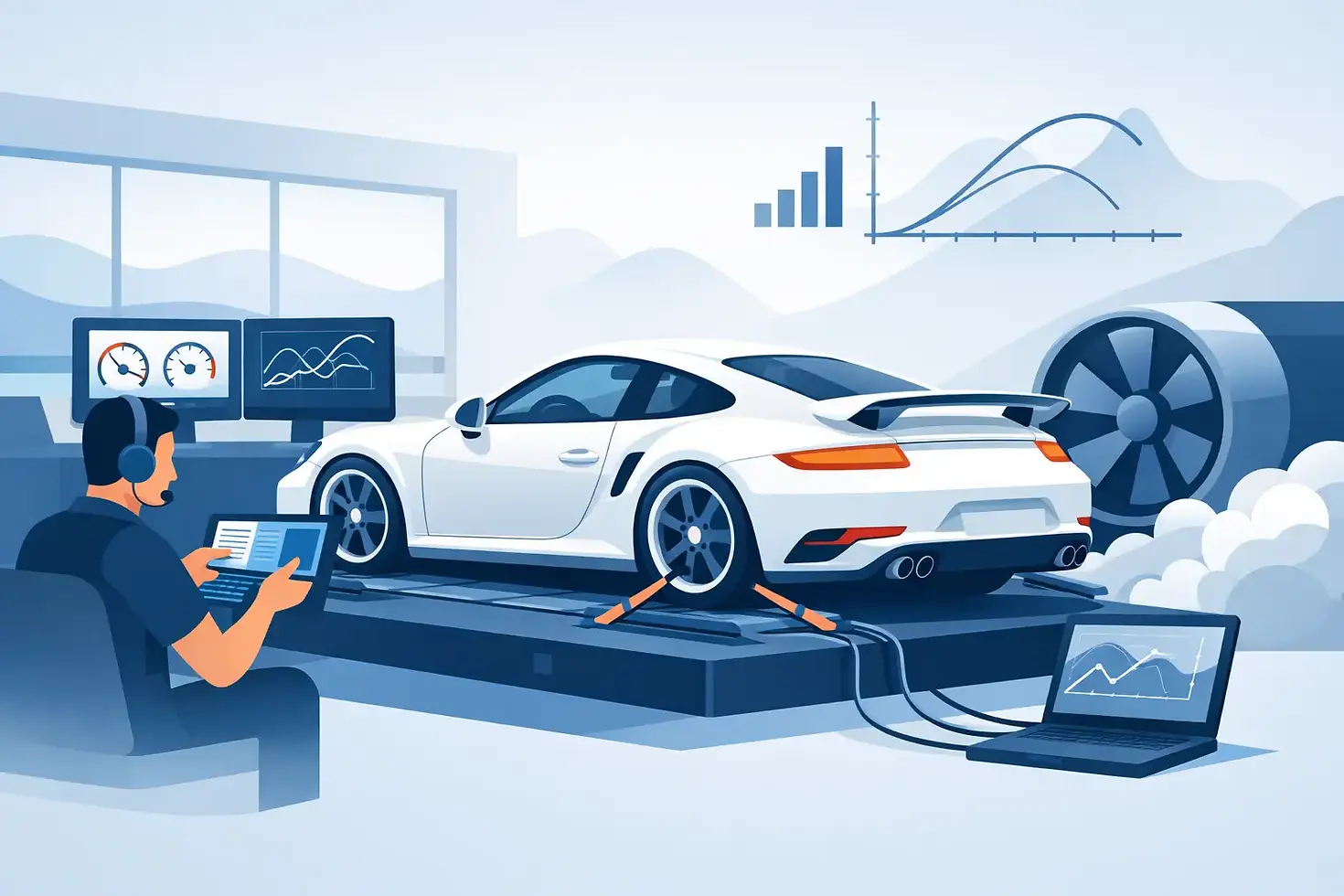
Dyno Tuning for Porsche: What to Expect

A Porsche that feels strong on the street can still be leaving power, response, and consistency on the table. That is exactly why dyno tuning for Porsche matters. On these cars, small calibration changes can produce meaningful gains, but only when they are tested against real data, controlled load, and platform-specific limits.
Porsche tuning is not a generic flash-and-go job. Whether the car is a turbocharged 911, a Cayenne, a Panamera, or a naturally aspirated GT platform, the calibration strategy has to respect engine design, thermal behavior, transmission logic, fuel quality, and the intended use of the vehicle. A proper dyno session is where those variables stop being guesses.
Why dyno tuning for Porsche is different
Porsche vehicles respond well to calibration, but they also expose weak tuning quickly. Knock control, torque intervention, boost targeting, throttle modeling, and gearbox interaction are all tightly managed. If the tune is too aggressive, the car may make a strong pull once, then pull back timing, close the throttle, or reduce boost as temperatures rise.
That is why dyno tuning is more than chasing a peak horsepower number. A serious calibration looks at repeatability. It verifies how the car behaves through multiple runs, how intake air temperature affects output, whether commanded boost matches actual boost, and whether fuel trims and ignition correction stay in a healthy range. On a Porsche, stable power delivery is usually more valuable than a flattering single-run number.
This becomes even more important on forced-induction models. Turbo Porsches can show impressive gains, but they can also reach the edge of safe operation faster than owners expect, especially with marginal fuel, pre-existing maintenance issues, or hardware that is not matched to the software. The dyno provides a controlled environment to see that clearly.
What a proper Porsche dyno session should measure
A quality dyno tune starts before the first pull. Baseline testing confirms that the car is healthy and performing consistently in current form. If the dyno graph is erratic, boost control is unstable, or the air-fuel profile is not where it should be, the tuning process should slow down until the cause is identified.
During calibration, the tuner should be reviewing more than horsepower and torque. Engine load, boost pressure, intake temperatures, ignition timing, knock activity, lambda or air-fuel ratio, rail pressure where applicable, and torque intervention all matter. On PDK-equipped cars, transmission behavior can also influence the result, particularly when torque modeling is involved.
The best dyno work also includes multiple revisions, not a single file loaded in hope. A measured approach usually means changing one calibration area at a time, validating the effect, and then deciding whether the result improves performance without creating risk. That process is slower than using a generic tune, but it is how you get a car that performs properly on the road and track.
Gains depend on the platform
One of the most common mistakes in Porsche tuning is talking about results as if every platform responds the same way. They do not. A turbocharged 991.2 Carrera, a 997 Turbo, and a Cayenne Turbo each have different control strategies, thermal characteristics, and tuning ceilings. Even within the same model line, fuel quality, mileage, supporting hardware, and ambient conditions can shift the outcome.
Turbocharged applications usually see the largest gains from dyno tuning because boost, torque targets, and ignition can be recalibrated with measurable effect. Naturally aspirated cars tend to show more modest peak gains, but often improve in throttle response, midrange delivery, and overall drivability. For many owners, especially on street-driven cars, that sharper and more linear powerband matters more than a dramatic dyno sheet.
There is also a difference between stock-hardware tuning and calibration for modified setups. An intake or exhaust alone may not require major changes, but upgraded intercoolers, hybrid turbos, fueling upgrades, or ethanol blends absolutely change the calibration path. The dyno is where those hardware changes are validated rather than assumed.
Dyno tuning for Porsche and drivability
Owners often ask about horsepower first, but drivability is where a well-built tune proves its value every day. Porsche engineers put a lot of effort into pedal mapping, torque management, and transmission behavior. If a tune ignores those areas and focuses only on peak numbers, the car can become abrupt, inconsistent, or less refined than it should be.
A strong dyno tune improves the way the vehicle responds across the rev range. Throttle input feels more proportional. Midrange torque arrives with better control. Power carries cleanly instead of tapering early or spiking unpredictably. On PDK cars, coordination between the engine calibration and transmission strategy can also improve how the car accelerates under part and full load.
This is one reason serious Porsche owners tend to prefer custom calibration over off-the-shelf files. A generic map may produce acceptable output, but it cannot account for the exact condition of your engine, local fuel quality, environmental conditions, or the specific combination of hardware on the car. Dyno tuning closes that gap with measured adjustments.
The trade-off between aggressive power and long-term reliability
Every tuning decision has a cost. More boost, more ignition advance, and more torque demand can all increase performance, but they also increase thermal load and mechanical stress. On a high-value platform like Porsche, the right question is not simply how much power is available. It is how much power is sensible for the car's use case.
A street-driven 911 that sees hot weather, stop-and-go traffic, and occasional spirited driving should not necessarily be calibrated like a car built for short pulls in ideal conditions. The same applies to track-driven vehicles, where repeated heat cycles expose weaknesses quickly. A tune that looks impressive on paper can become a liability if it does not maintain control as temperatures climb.
This is where data-driven dyno calibration stands apart. Instead of tuning to the edge and hoping factory safeguards catch problems, the calibration is built with headroom. That means realistic boost targets, safe ignition strategy, proper fueling under load, and a torque model the ECU and transmission can manage predictably. At ECUPROGRAM, that kind of disciplined validation is what turns tuning into a technical service rather than a marketing claim.
When a Porsche should not be tuned yet
Not every car is ready for calibration the day it arrives. If there are unresolved fault codes, boost leaks, weak coils, carbon buildup, fuel delivery issues, transmission adaptation problems, or cooling concerns, tuning should wait. The dyno often reveals these issues faster than the street because the car is being loaded in a repeatable way.
That may sound inconvenient, but it protects the owner. A calibration should never be used to mask a mechanical or electrical problem. On modern Porsche platforms, especially those with complex electronic management, poor hardware condition can distort data and lead to false tuning decisions. Fixing the root issue first almost always produces a better long-term result.
Choosing the right tuner for a Porsche dyno session
Porsche owners should expect platform knowledge, not just dyno access. Running a car on a dyno is easy. Understanding Porsche load control, torque intervention, turbo management, and transmission interaction is where expertise shows. The tuner should be comfortable reading the data behind the graph and explaining why the calibration is being adjusted a certain way.
It also helps to ask what success looks like before the session starts. On some cars, the goal is maximum safe power on premium pump gas. On others, it may be smoother part-throttle behavior, better response, or a calibration built around upgraded hardware. Clear targets lead to better decisions and a more useful result.
For Porsche owners, the best tune is rarely the loudest one in the market. It is the one that starts clean, pulls hard, repeats consistently, and behaves properly in the real conditions where the car is driven. That is what dyno tuning should deliver when it is done with discipline, data, and respect for the platform.
If you are considering calibration work, think beyond the headline number. A properly tuned Porsche should feel sharper, more predictable, and more complete every time you drive it.


Comments