

European Performance Tuning Guide for Real Results
- Miguel Acha
- Jul 17
- 6 min read

A properly executed european performance tuning guide starts with a simple principle: the calibration must suit the vehicle, its hardware, its fuel, and the way it is actually driven. A generic file may change a dyno number, but it cannot account for an individual engine’s condition, transmission behavior, heat management, or intended use. On a Mercedes diesel, Audi TDI, Porsche, AMG, or exotic platform, those details determine whether added performance feels controlled or becomes an expensive liability.
European vehicles respond exceptionally well to intelligent software because their factory control strategies are sophisticated. The same complexity also means performance work should be approached as an engineering process, not a collection of parts. The goal is measurable power, predictable drivability, and operating margins that make sense for the platform.
European Performance Tuning Guide: Start With Vehicle Health
Before increasing torque targets or boost pressure, establish a reliable baseline. Modern European powertrains depend on accurate inputs from sensors, airflow systems, fuel systems, cooling circuits, and driveline controllers. A weak component that feels minor at stock power can become obvious once cylinder pressure and torque demand increase.
A proper pre-tuning inspection should include a complete fault-code scan, live-data review, and verification of service history. On turbocharged gasoline engines, this may mean checking boost consistency, ignition corrections, fuel trims, high-pressure fuel delivery, and intercooler performance. On common-rail diesels, injector balance, rail pressure, turbo actuator operation, charge-air leaks, and diesel particulate filter condition deserve close attention.
Transmission condition matters just as much. A dual-clutch, automatic, or automated manual transmission may limit engine torque to protect clutches, gears, and internal hydraulic components. If the transmission is already showing delayed engagement, flare, harsh shifts, or adaptation issues, solve that problem before requesting more engine output.
This baseline protects the vehicle and gives the calibration process useful data. It also prevents a tuner from confusing a mechanical fault with a software limitation.
ECU Calibration Is More Than Peak Horsepower
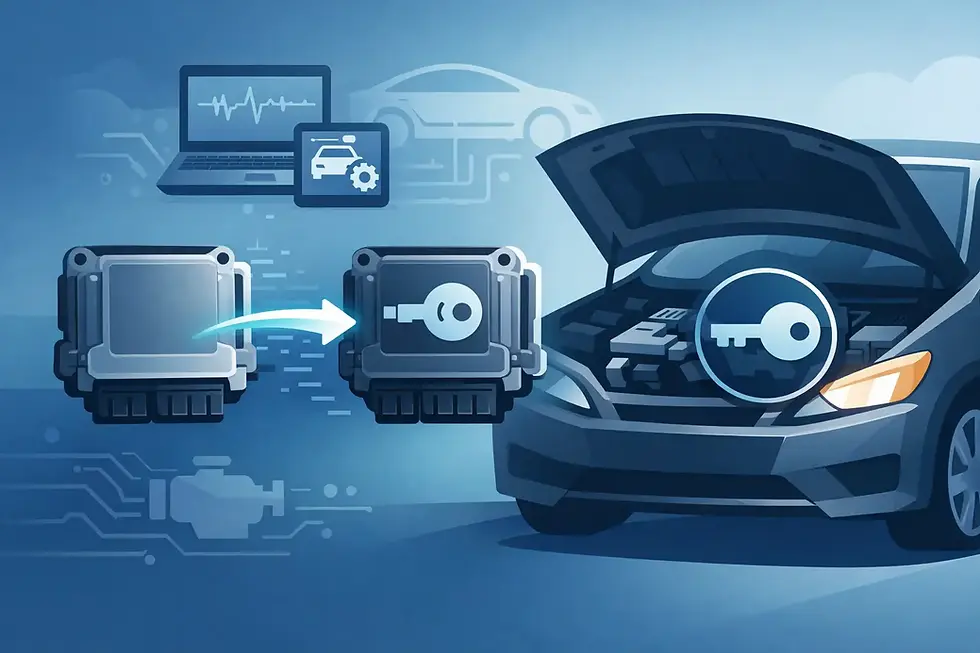
An ECU calibration changes the way the engine manages torque. Depending on the platform, it can revise boost control, fueling, ignition timing, throttle mapping, load targets, torque limiters, camshaft strategy, and thermal safeguards. The best result is not necessarily the largest peak number. It is a power delivery that matches the engine’s safe operating range and the owner’s priorities.
For a daily-driven Audi S or RS model, the priority may be stronger midrange response and consistent performance in summer heat. A Mercedes-Benz diesel owner may want improved low-end torque, better towing behavior, and more efficient highway operation. A Porsche owner preparing for track use may value repeatable output after several hard laps instead of a brief peak-power pull.
Fuel quality is central to this decision. Higher-octane gasoline can support more aggressive ignition timing when the engine and calibration are designed for it, but a tune built around premium fuel should not be treated as flexible when lower-grade fuel is the only option. Ethanol blends can provide substantial knock resistance and cooling potential, yet they require sufficient fuel-system capacity and a calibration built for the actual blend. Diesel calibrations similarly depend on fuel quality, injection-system condition, and realistic exhaust-temperature management.
A disciplined tuner also preserves appropriate protection strategies. Knock control, temperature-based torque reduction, boost monitoring, and fuel-pressure safeguards exist for a reason. Calibration should improve the vehicle’s behavior without blindly removing the systems that help protect it.
Dyno Validation Turns Claims Into Data
Dyno testing is not just a marketing tool. It provides a controlled way to measure wheel horsepower, wheel torque, boost behavior, air-fuel ratio, intake temperature, and consistency from run to run. On high-value European vehicles, those data points are more meaningful than a promise attached to a generic stage label.
A baseline dyno pull shows what the vehicle produces before any changes. That number is influenced by drivetrain loss, tire setup, ambient temperature, correction method, and dyno type, so it should be used primarily as a comparison on the same equipment under similar conditions. The important question is not whether one car matches an internet number. The important question is whether the vehicle improves safely, repeatably, and in the areas the owner can use.
Data logging complements dyno work. Road logs reveal behavior during heat soak, sustained load, gear changes, and real-world airflow conditions. A calibration that looks clean in one controlled pull may need refinement if it shows inconsistent boost control, ignition correction, transmission intervention, or rising temperatures on the road.
At ECUPROGRAM, this is where in-house dyno validation and platform-specific diagnostics add value. The calibration process can be informed by measured behavior rather than assumptions about what every vehicle of a given model should do.
Match Transmission Software to Engine Torque
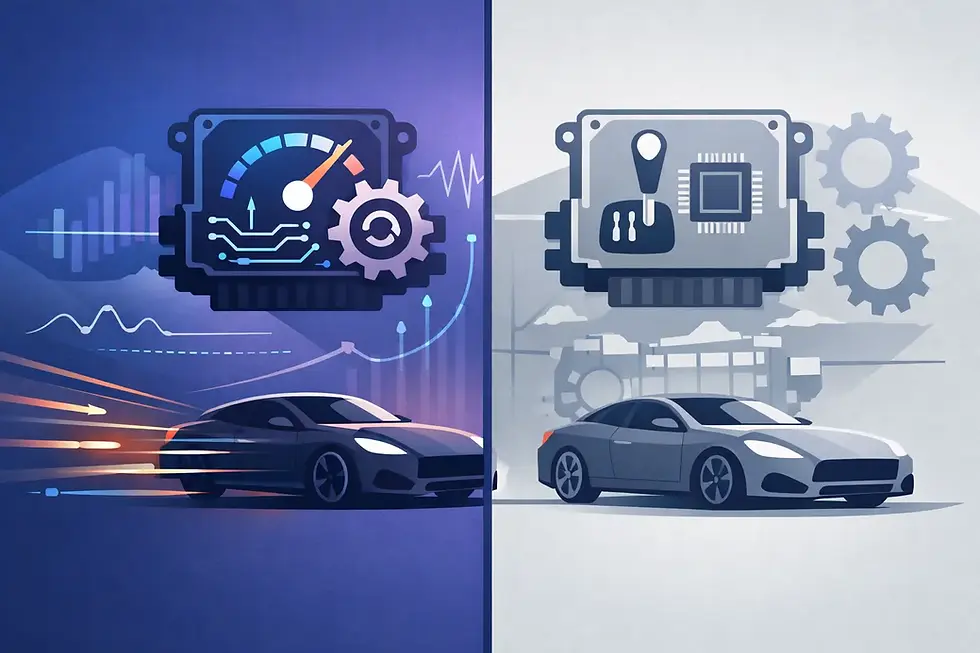
Engine tuning without transmission optimization can leave performance on the table. Many European transmissions use torque models that communicate continuously with the ECU. When engine output exceeds the factory-calibrated expectation, the transmission may request torque reduction, shift early, shift softly, or apply clamping pressure that does not fully suit the increased load.
Transmission software can refine shift timing, torque limits, clutch pressure, manual-mode behavior, and launch strategy where the platform supports those changes. The benefit is often felt more clearly than a small horsepower increase: faster response on upshifts, fewer unwanted kickdowns, and more confident acceleration through the gears.
There is still a trade-off. Higher clutch pressure and faster shifts can improve torque capacity, but excessive aggression can reduce refinement and increase stress on worn components. The right calibration depends on whether the vehicle is a daily driver, a long-distance grand tourer, a tow vehicle, or a track-focused build.
Hardware Should Support a Clear Calibration Plan
Not every modification needs to happen at once. In fact, staged development is usually the smarter approach. Start with maintenance and baseline testing, then choose hardware that addresses an actual restriction or supports a specific power target.
For a modest ECU calibration, the factory intake and exhaust hardware on many European platforms may be adequate. As airflow and boost targets rise, upgraded charge cooling, freer-flowing intake components, fuel-system upgrades, turbocharger changes, and exhaust improvements may become necessary. The exact order varies by engine family. A turbocharged BMW or VW/Audi gasoline platform has different weak points than a Mercedes OM diesel or a naturally aspirated Ferrari.
Avoid buying parts because they are common in online build sheets. A larger turbo without enough fuel supply, cooling capacity, or transmission support creates a mismatched package. An exhaust modification that adds sound but does not address a true bottleneck may change the character of the car without advancing the performance goal.
Emissions-related modifications also require care. Federal and state laws restrict tampering with emissions-control systems on vehicles used on public roads. Any vehicle work should remain compliant with applicable law, inspection requirements, and the vehicle’s intended use. A professional shop should be direct about those boundaries rather than treating them as an afterthought.
Reliability Is a Performance Modification
European performance vehicles reward owners who stay ahead of maintenance. Fresh spark plugs with the correct heat range and gap, quality fluids, healthy coils, clean filters, properly functioning cooling components, and current transmission service can make a tuned vehicle feel more consistent than a larger hardware upgrade.
Heat is often the limiting factor. Repeated acceleration, high ambient temperatures, and track sessions raise intake-air, coolant, oil, and transmission temperatures. A calibration that is sensible for street driving may need different expectations for a vehicle that sees extended full-throttle operation. This is why logs, service history, and intended use should be part of the tuning conversation from the beginning.
Warranty coverage, insurance requirements, and resale considerations also belong in the decision. Some owners want conservative, reversible improvements with minimal changes to vehicle character. Others are building toward a defined power target and accept the maintenance and component costs that follow. Neither approach is wrong, but each requires an honest calibration strategy.
Choose a Specialist, Not a File
The most useful tuning partner understands the specific vehicle beyond its advertised output. They should be able to explain what the ECU and transmission software will change, what data will be monitored, what supporting maintenance is recommended, and where the practical limits are for your configuration.
Ask whether the vehicle will be scanned and evaluated before tuning, whether results are validated on a dyno or through logs, and whether the shop can diagnose module, immobilizer, DME, or communication faults if the project uncovers an electronic issue. On premium European platforms, performance and electronics are closely connected. A tuner with diagnostic depth can address the full system instead of treating every problem as a request for more power.
The best next step is not choosing the highest advertised stage. Establish the vehicle’s condition, define how you want it to perform, and build the calibration around measurable data. That approach produces the kind of improvement you can feel every time the road opens up.

Comments