

How to Improve Porsche Throttle Mapping Properly
- Miguel Acha
- Aug 4
- 6 min read

A Porsche can make strong power yet still feel hesitant when you first ask for it. A soft initial pedal, a delayed downshift, or a surge as boost arrives can make the car feel less precise than its chassis deserves. Learning how to improve Porsche throttle mapping starts with separating pedal feel from actual engine output, then calibrating the system around the specific engine, transmission, fuel, and intended use.
Throttle mapping is not simply a setting that makes the electronic throttle body open faster. On modern Porsche platforms, it is part of a torque-management strategy shared by the DME, transmission controller, boost control system, traction management, and selected drive mode. A good calibration makes the car respond with greater intent while retaining predictable modulation, drivetrain protection, and factory-level drivability.
What Porsche Throttle Mapping Actually Controls
In an electronic throttle control system, the accelerator pedal is a torque request. The DME interprets pedal position, engine speed, load, intake temperature, gear selection, drive mode, traction-control status, and other inputs before deciding how much torque to deliver. Throttle angle is only one part of that result.
That distinction matters on turbocharged Porsche models. A more aggressive pedal map can request torque earlier, but the DME may still limit delivery based on boost targets, charge-air temperature, knock control, gear-based torque limits, or transmission protection. On naturally aspirated cars, throttle calibration often has a more immediate effect on tip-in and mid-range response, although ignition, cam timing, airflow, and fuel quality still determine the final result.
Factory mapping is designed to work across broad conditions and driver profiles. It may prioritize smoothness, emissions control, traction, drivetrain longevity, or a deliberate separation between Normal and Sport modes. That is sensible for an OEM calibration, but it can leave a performance-oriented owner wanting a more direct relationship between pedal input and vehicle response.
Diagnose the Delay Before Changing the Map
The wrong answer to a lazy-feeling Porsche is not always more pedal sensitivity. A throttle map cannot repair a mechanical, fuel, air, ignition, or transmission issue. If the car has inconsistent response, warning lights, boost deviation, rough idle, hesitation under load, or a noticeable change from its normal behavior, diagnostics should come first.
A proper evaluation includes a full module scan, fault-code review, live data analysis, and a road or dyno pull where appropriate. On forced-induction applications, useful data includes requested versus actual boost, throttle angle, ignition correction, air-fuel ratio, intake-air temperature, high-pressure fuel performance, and calculated torque. On PDK-equipped models, the tuner should also evaluate requested torque, delivered torque, clutch behavior, shift timing, and torque intervention during shifts.
Common causes of dull response include intake leaks, diverter valve issues, carbon buildup on certain direct-injection engines, weak ignition components, fuel-pressure faults, outdated software, or transmission adaptations that no longer match the vehicle's condition. Correcting the root cause preserves reliability and ensures a subsequent calibration produces repeatable results.
Improve Porsche Throttle Mapping With ECU Calibration
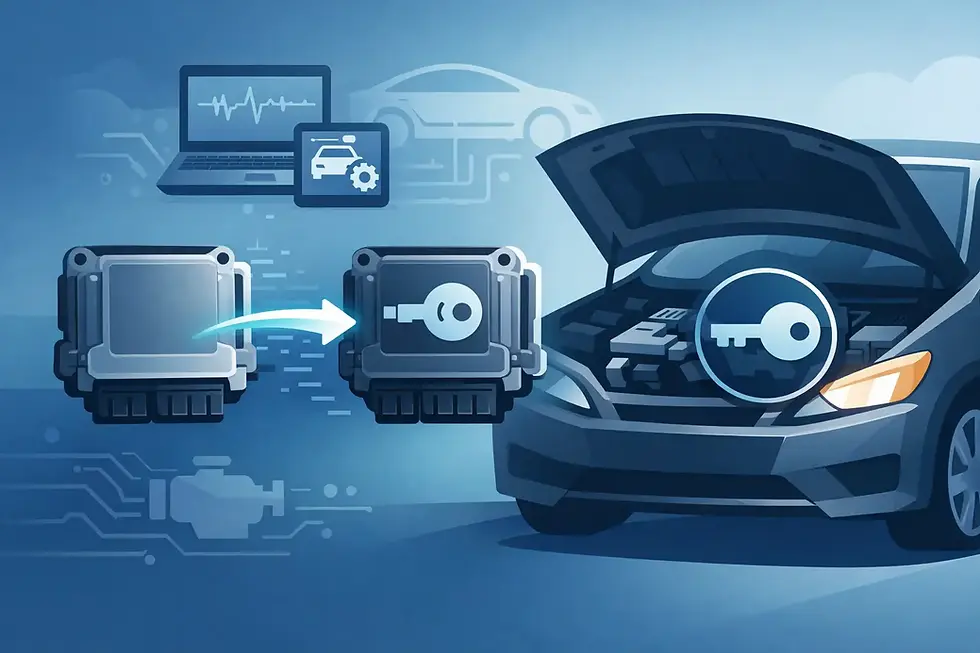
A custom ECU calibration is the most effective way to alter throttle behavior because it addresses the pedal-to-torque request tables inside the DME. Rather than relying on a generic sensitivity increase, a specialist can reshape the early, middle, and final sections of pedal travel according to the engine's torque curve and the driver's priorities.
For a street-driven 911, Cayenne, Macan, Panamera, or Taycan-era performance platform, the best result is usually not an overly sharp first 15 percent of pedal travel. That type of tune can feel exciting during a brief test drive but become tiring in traffic, on wet roads, or through low-speed corners. It also reduces the driver's ability to meter torque precisely.
A disciplined calibration typically keeps light-throttle behavior smooth, removes unnecessary hesitation in the mid-pedal range, and provides a stronger, linear response as pedal demand increases. The goal is controlled acceleration, not an artificial on-off switch.
On turbocharged Porsche engines, throttle mapping should be coordinated with boost, torque model, wastegate, fueling, and ignition calibration. If the pedal requests more torque but the torque model and boost strategy are not properly aligned, the vehicle may close the throttle, pull timing, limit boost, or create inconsistent delivery. That is why a true performance calibration produces a better result than a pedal-only modification.
Why Pedal Controllers Have Limits
Pedal controllers can change the signal between the accelerator pedal and the vehicle's control module. They can make a Porsche feel more immediate by amplifying the pedal signal, and they are often quick to install and remove. For an owner seeking a temporary change in sensitivity, that may be appealing.
However, a pedal controller does not create additional engine torque, recalibrate boost control, improve fueling, optimize ignition, or change transmission torque intervention. It changes perceived response rather than the engine's underlying capability. In some cases, the initial response becomes too abrupt while the actual power delivery remains unchanged.
This does not make a pedal controller inherently wrong. It is simply a limited tool. If the car is mechanically sound and the owner only wants a more assertive pedal feel without ECU software changes, it may fit the objective. If the goal is measurable power, cleaner torque delivery, and calibrated behavior through the full operating range, ECU and transmission software are the more complete solution.
Match PDK and Tiptronic Behavior to Engine Response
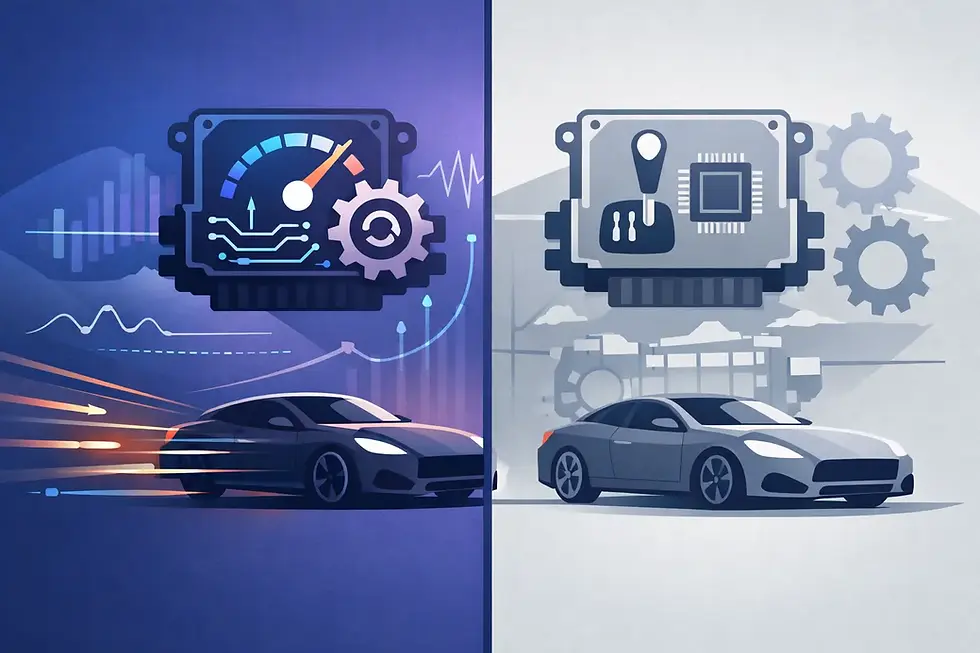
On Porsche models with PDK or Tiptronic transmissions, perceived throttle lag often comes from the gearbox rather than the engine. The engine may respond correctly, but the transmission is holding a tall gear, delaying a downshift, or applying torque limits during a shift. Improving engine pedal mapping without addressing transmission behavior can leave part of the problem unresolved.
Transmission software optimization can adjust shift scheduling, shift speed, clutch pressure where appropriate, torque intervention, kickdown logic, and manual-mode behavior within safe operating limits. The benefit is not only faster shifting. It is a more coherent response when the driver asks for acceleration.
For example, a calibrated PDK strategy can downshift with greater decisiveness in a performance mode and coordinate the engine's torque request more cleanly through the shift event. The car feels sharper because the DME and transmission controller are working from compatible torque expectations. On a high-torque turbo platform, this coordination is also critical for protecting clutch packs and maintaining consistent performance.
Use Data Logging and Dyno Validation
No two vehicles are identical, even when they share the same model year and engine code. Fuel quality, altitude, climate, modifications, maintenance history, and transmission condition all affect the calibration window. A data-driven process is what turns a throttle adjustment into a dependable tuning solution.
Dyno testing establishes a baseline and shows how torque builds across the rev range. Data logging verifies that requested torque, actual torque, boost, fueling, and ignition behavior remain within acceptable limits under real load. This is particularly valuable when the vehicle has upgraded intake components, intercoolers, exhaust hardware, turbochargers, or fuel-system changes.
At ECUPROGRAM, the calibration process is centered on vehicle-specific diagnostics and validated results rather than a one-size-fits-all throttle file. That approach matters because the best throttle map is one that complements the complete powertrain strategy, not one that only feels aggressive in the parking lot.
Choose the Right Response for How You Drive
The ideal map depends on how the Porsche is used. A daily-driven Macan GTS may benefit from a cleaner mid-pedal response and improved downshift logic without making low-speed operation abrupt. A track-focused 911 may justify more immediate pedal demand, firmer transmission behavior, and a calibration built around predictable corner-exit torque. A high-output Turbo or Turbo S needs careful torque management so stronger response does not create unnecessary heat, traction loss, or transmission stress.
Drive modes should remain meaningful whenever possible. Normal can retain refined low-load behavior, while Sport and Sport Plus can deliver more urgent torque request and shift strategy. This preserves flexibility instead of forcing one aggressive setting into every situation.
Fuel should also match the tune. A calibration developed for premium pump fuel should not be treated as though it has the knock resistance of ethanol blends or race fuel. Likewise, hot-weather driving and repeated hard pulls require more conservative thermal management than a single cool-weather dyno run.
The Better Standard Is Predictability
The most effective throttle calibration does not make a Porsche feel nervous. It makes the car easier to place, easier to modulate, and more responsive when the driver commits to the pedal. Smooth low-speed control, immediate mid-range acceleration, and consistent behavior through a shift are more valuable than exaggerated sensitivity.
Before changing software, confirm the vehicle is healthy. Then calibrate the pedal map, engine torque model, and transmission strategy as one system. That is how a Porsche gains sharper response without sacrificing the mechanical discipline that makes real performance repeatable.

Comments