

What a VW Diesel Calibration Service Should Do
- Miguel Acha
- Jul 11
- 5 min read

A late-model VW TDI can feel stronger or weaker than its factory power figure suggests. Torque delivery, transmission behavior, boost control, fuel quality, altitude, and accumulated wear all shape the driving experience. A proper VW diesel calibration service addresses those variables through measured ECU strategy, not a generic file loaded without diagnosis.
For VW diesel owners, the goal is rarely peak horsepower alone. The better result is a vehicle that delivers torque cleanly, responds predictably, shifts with intent, and operates within sensible thermal and mechanical limits. That requires platform knowledge, accurate logging, and validation under load.
What a VW Diesel Calibration Service Should Deliver
The ECU controls far more than fuel quantity. On a modern VW TDI platform, calibration affects boost targets, injection timing and duration, torque modeling, rail pressure, smoke limitation, throttle behavior, exhaust temperature management, and torque requests sent to the transmission controller. These systems must work together.
A well-developed calibration begins with the vehicle in front of the tuner. Engine condition matters. A boost leak, sticking actuator, restricted fuel filter, weak battery voltage, injector imbalance, DPF-related fault, or transmission issue can distort the results of any software change. Calibration should not be used to mask a mechanical or electronic problem that requires repair.
Once the vehicle is confirmed healthy, the tuner can review baseline data and identify how the engine is actually operating. This includes requested versus actual boost, intake air temperature, fueling behavior, rail pressure, exhaust temperature where available, torque intervention, and transmission response. On diesel platforms, clean data is the difference between a controlled power increase and a calibration that looks acceptable only on paper.
The best files also preserve drivability. Excess low-rpm torque may feel impressive during a short test drive, but it can create harsh launches, excessive wheelspin, clutch stress, unwanted transmission intervention, and heat. A more disciplined torque curve often feels faster because the vehicle delivers power consistently through the usable rev range.
Why Generic TDI Tunes Fall Short
Many VW diesel owners have seen advertised tuning numbers that appear nearly identical across multiple years, engine codes, and hardware configurations. That is a warning sign. A common-rail TDI, a PD TDI, and an older rotary-pump diesel do not share the same control strategy, hardware limits, or diagnostic priorities.
Even two vehicles with the same engine code can require different decisions. One may have upgraded intercooling or a freer-flowing intake, while another is a daily driver in hot weather with high mileage. One may be paired with a DSG transmission, another with a manual clutch nearing its limit. The calibration should reflect the complete vehicle, its use, and the owner's expectations.
Off-the-shelf files can also produce problems that are not immediately obvious. Overly aggressive boost control can increase turbocharger workload. Excessive fueling without appropriate airflow can create smoke and elevated exhaust temperatures. Poor torque model calibration may cause inconsistent throttle response, limp-mode events, or transmission behavior that feels indecisive under load.
A data-driven process avoids chasing a single dyno number at the expense of reliability. At ECUPROGRAM, calibration work is approached as an engineering exercise: establish a baseline, diagnose irregularities, calibrate deliberately, then validate the result with measured data and dyno testing when appropriate.
Torque Management Is a Major Part of the Job
Torque management is particularly important on VW/Audi diesel vehicles. The engine ECU calculates and reports torque to other modules, especially the transmission controller. If those values are poorly coordinated, the vehicle can reduce power unexpectedly, shift poorly, or generate fault conditions.
For DSG-equipped vehicles, engine tuning and transmission software should be considered together. A transmission calibration can improve shift logic, clutch pressure strategy, torque limits, and gear selection behavior. It is not always required, but it becomes more relevant as engine torque rises or when the factory shift behavior does not suit the intended use.
Manual-transmission cars have a different trade-off. A strong low-end torque tune may exceed the capacity of an aging stock clutch long before the engine reaches its potential. In that case, a torque-managed calibration may be the sensible choice until supporting hardware is installed.
The Right Calibration Depends on How You Drive
A commuter-focused VW diesel does not need the same strategy as a vehicle used for towing, long highway travel, or spirited weekend driving. Calibration should start with a clear use case.
For a daily-driven TDI, the priorities are often smoother part-throttle response, cleaner midrange torque, predictable cold-start behavior, and efficient cruising. The objective is not to make the pedal overly sensitive. It is to reduce the hesitation and flat spots that make factory torque delivery feel restrained.
For towing or heavy-load use, the focus shifts toward sustained thermal control and usable torque rather than an aggressive peak figure. The vehicle must maintain consistent performance under load, not just make a strong single dyno pull. Intercooler efficiency, cooling system condition, transmission capacity, and ambient temperature deserve attention before major torque increases are requested.
For performance-oriented builds, supporting hardware becomes a larger part of the conversation. Turbocharger selection, intake and charge-air cooling, fueling capacity, exhaust configuration, clutch or DSG capability, and traction all influence what the final calibration can safely deliver. The software should be built around the parts and verified after each significant change.
Dyno Testing and Data Logging Provide the Proof
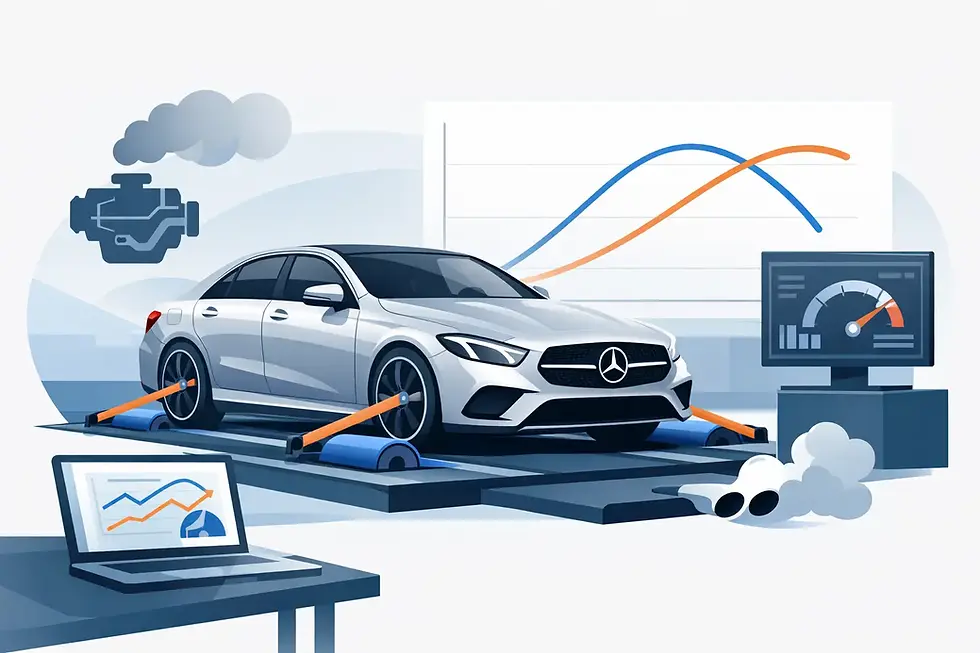
A chassis dyno is not simply a marketing tool. Used correctly, it provides a controlled way to compare baseline and calibrated performance while monitoring the variables that affect engine safety and consistency. The number itself matters less than the shape of the power and torque curves, repeatability between runs, and the supporting data behind the result.
Data logging fills in what a dyno graph cannot show by itself. It can reveal boost deviation during real road acceleration, temperature behavior in changing ambient conditions, torque reductions commanded by the ECU, and transmission response through multiple gears. Road logging is especially valuable for diagnosing a complaint that only appears under certain loads or speeds.
There are limits to every test method. Dyno results vary by equipment, correction method, tire condition, gear selection, and vehicle setup. Road logs vary with weather, grade, and driver input. A professional calibration service uses both tools as evidence, rather than presenting one impressive result as the entire story.
Emissions Compliance Is Not an Afterthought
VW diesel vehicles use emissions systems that are integrated into engine control strategy. In the United States, removing, disabling, or defeating required emissions equipment on a street-driven vehicle is not legal. A responsible service provider should be direct about that limitation.
If a warning light, regeneration concern, sensor fault, or drivability issue is connected to the emissions system, the first step is accurate diagnosis. The repair may involve a sensor, wiring, intake leak, exhaust component, control module issue, or a mechanical condition affecting normal operation. Proper diagnostics protect both the vehicle and the owner from spending money on the wrong solution.
A legal calibration can still improve the way a VW diesel drives. Better torque delivery, refined throttle mapping, calibrated boost control, and transmission coordination can create meaningful gains without treating compliance as optional.
Choosing a Specialist for VW TDI Calibration
Ask how the tuner evaluates vehicle condition before software is installed. Ask whether the calibration is matched to your engine code, transmission, hardware, fuel, and intended use. Ask what data is monitored, whether results are validated, and how the shop handles a vehicle that shows mechanical faults before tuning begins.
The answers should be specific. A specialist should be able to explain the relationship between torque targets, airflow, fuel delivery, thermal control, and transmission limits without relying on vague promises. They should also be honest when a stock clutch, marginal turbocharger, or unresolved fault makes a requested power target a poor decision.
The right VW diesel calibration is not the one with the largest advertised claim. It is the one that makes your particular vehicle more responsive, more consistent, and better matched to the way you use it - with the diagnostic discipline to keep the result defensible long after the first drive.


Comments